
Each Dawn I Die
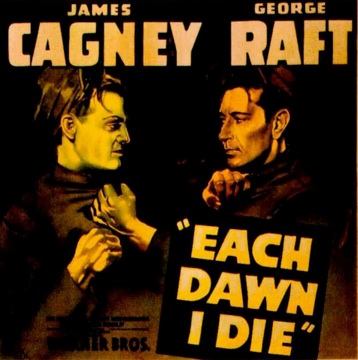
Movie a Day Blog has always enjoyed the signature Warner Bros. films of the 1930s, when they were preoccupied with gangsters, criminals, prisoners, the disadvantaged and mistreated. These films were made less because of a pronounced social conscience and more because they were inexpensive black and white productions that could use generic urban or confined settings. There was a hardboiled quality to the slang-based dialogue and tough guy and gal characterizations that endeared the Warner Bros. movies and stars to working class America, who saw their aspirations and the limitations to their dreams reflected in these hard-charging stories of the rise and fall of power in urban America. Given all that, EACH DAWN I DIE is a bit of a disappointment, not up to the defining films of the era, THE PUBLIC ENEMY (William Wellman, 1931), LITTLE CAESAR (Mervyn LeRoy, 1931) and SCARFACE (Howard Hawks, 1932). Even by the late 1930s, the premise of the framed innocent corrupted by brutal prison life was a familiar one, and William Keighley’s generic direction doesn’t enliven it much. Cagney plays a cocky newspaper reporter hot on a big corruption scandal involving the mob, the mayor and some business fronts used to launder money. In short order, the bigwigs order him to be taken care of, and he’s knocked out, has liquor spilled all over him, and sent careening down a street in a car, passed out at the wheel. It has the misfortune to hit an oncoming vehicle and kill three teenagers. The crooked system makes sure that Cagney’s convicted of vehicular manslaughter and sentenced to 20 years in what was still known as The Big House, since the prison movie genre was relatively young. Cagney plays such a stand-up guy that he quickly earns respect in prison and the unwanted friendship of oily mobster George Raft. Never the most accessible nor dynamic of tough-guy actors, Raft was often little more than a gangster clotheshorse, the demands made on his limited acting skills thankfully minimal. He’s surprisingly effective in EACH DAWN I DIE, with his hawk-like features focused solely on personal revenge for each perceived slight against him. The corruption of the system is soft-pedaled in Keighley’s pedestrian treatment of potentially explosive material, with an especially kind-hearted warden played by a puffy-looking, aging George Bancroft, mitigating any sense of iniquity. Only John Wray’s sadistic guard Pete gives an indication of how brutal the pre-World War II penal system could be – there sure were a lot of riveted steel doors from the look of this film, and they were needed. Revenge was all that mattered – that, and not ratting out your fellow cons. Cagney ends up discovering a much fairer and more judicious system of societal rule in prison, and it makes life outside the prison, with its rotten and corrupt core, look less attractive. The most distinctive aspect of EACH DAWN I DIE, other than the performances of Cagney and Raft, is the patented black-and-white Warner Bros. look that cinematographer Arthur Edeson and art director Max Parker achieve. The use of light and shadow is defining in EACH DAWN I DIE, and the visual presentation is given substance and mood by Max Steiner’s uncredited but powerful score. There are a couple of classic 1930s time montages, one for George Raft in the hole, and another for Cagney’s long wait for justice that sees him transformed into a bitter and rabidly violent con. Jimmy is redeemed by the end, as even a bad guy like Raft won’t welsh on a deal. Men were men and emotions were simpler, at least on the Hollywood big screen in the pivotal movie year of 1939. EACH DAWN I DIE doesn’t turn up on anyone’s list of great movies from that greatest of movie years, but it’s an excellent example of the Warner Bros. visual style that was unique among the major studios.
Dir.: William Keighley, 1939. 92 min. B&W. Warner Bros. Pictures. Produced by Hal B. Wallis, David Lewis. Screenplay by Norman Reilly Raine, Walter Duff, based on novel by Jerome Odlum. Cinematography by Arthur Edeson. Edited by Thomas Richards. Art direction by Max Parker. Music by Max Steiner. With James Cagney, George Raft, Jane Bryan, George Bancroft, Max Rosenbloom, Stanley Ridges, Alan Baxter, Victor Jory, John Wray, Edward Pawley, Willard Robertson, Emma Dunn, Paul Hurst, Louis Jean Heydt, Joe Downing, Thurston Hall. Viewed on DVD.
Saturday, June 25, 2011

New Class in April 2011

Skywalking:
The Life and Films
of George Lucas
Filled with revelations about the origins and making of American Graffiti, Star Wars, The Empire Strikes Back, Raiders of the Lost Ark, Read More
Dale Pollock will be offering a new class at Reynolda House this spring as part of the Portals of Discovery program. “From High Noon to Noir: American Cinema of the ‘50s” will take place on six Tuesday evenings from 6-9 p.m. beginning April 5, 2011 and ending May 17, 2011 in Reynolda House’s auditorium. Each week Dale will introduce a 1950s cinema classic and lead a discussion following the film. To register go to www.reynoldahouse.org.



Contact and Follow







I watch at least one movie every day and write about it. These are not reviews, but mini-essays on aspects of the film that I find interesting. Look for a new film discussed each and every day!


Dale M. Pollock is an award-winning teacher, writer and filmmaker. He is based in Winston-Salem, NC where he is a Professor of Cinema Studies and Producing at the University of North Carolina School of the Arts. Read more


DALE’S RATING: 3 popcorns
Photo by Diana Greene



