
Cornered (1945)
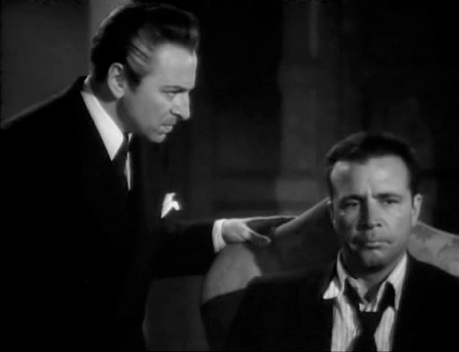
The idea that Dick Powell could have been a dramatic anti-hero drawn to dark, self-incriminating material would have been ridiculous to both movie audiences and executives in the 1930s. Powell was the lifeblood of the Warner Bros. movie musical in that era, starring in classics such as 42nd STREET (Lloyd Bacon, 1933) and the GOLD DIGGERS series that began with GOLD DIGGERS OF 1933 (Mervyn LeRoy, 1933) and continued with editions in 1935 and 1937, directed respectively by Busby Berkeley and Lloyd Bacon. But Powell was a shrewd businessman as well as an astute judge of his own talents, and broke out of his typecasting as the ever-optimistic singer/hoofer with a vengeance in MURDER, MY SWEET (Edward Dymytryk, 1944). His Philip Marlowe redefined him as a screen presence, and was probably the most faithful rendition of Raymond Chandler’s put-upon shamus, or private eye. The surprise success of the first Marlowe film had RKO rushing producer Adrian Scott and director Dymytryk to put together another compelling role for Powell in the same dark style that characterized MURDER, MY SWEET. No one was calling it Film Noir at that point, of course – the French had their own problems, as this film vividly demonstrates by focusing not on the Nazis who invaded France, but the quislings who collaborated with them. Continuing to explore the dirty and determined personality he established in his interpretation of Marlowe, Powell plays a Canadian air force lieutenant who married a French resistance fighter killed in the latter part of the war. He’s emotionally devastated, physically exhausted and pointedly cynical – in other words, much like all the other veterans returning to North America. The Canadian citizenship doesn’t really mean anything in the film, which is a lost opportunity to explore the war’s impact on a different culture and country. Instead, the script by John Paxton just overlays American grit and determination on a Canadian passport, as Powell begins a relentless manhunt for his wife’s killers. Once again, Griffith Park serves as a French locale, right down to the graves in which Powell’s wife’s remains are laid – it’s in Bronson Canyon, where I shot scenes for one of my films, SFW (Jeferey Levy, 1994). By this time, Dymytryk’s use of high contrast lighting for the purposes of production efficiency was already well known, and cinematographer Harry Wild, who also shot MURDER, MY SWEET and several other Noirs, has the look down pat – deep shadows, Dutch camera angles and overhead shots. Powell, looking depressed, sweaty and disheveled (his clothes often don’t match, with a jacket from one suit and pants from another) thinks he’s hit the jackpot when he finally tracks down Walter Slezak, playing another heavy with his innate sense of menace. But nothing in the postwar world is what it seems, and the elusive figure of key collaborator Marcel Jarnac constantly torments Powell by being just outside of his reach. Meanwhile, France (remember, it’s really the RKO lot and Griffith Park) is in rubble, but surprisingly quickly, the story moves to Buenos Aires, Argentina, where the French Vichy leaders have joined their German counterparts in hiding. There were several films of this period that explores the South American welcome given to fascists of all stripes, most notably GILDA (Charles Vidor, 1946), but few focus on the Vichy betrayers. Powell literally stalks his prey through a plot-heavy narrative, but encounters some great character actors along the way, especially Jack La Rue as a highly suspicious valet, and Luther Adler as the mysterious Jarnac – he shows what an impact an actor can make in just a few minute of one scene in the movie. Powell is tough but dumber than his Marlowe predecessor, although the moment of joy he feels when he thinks he finally has caught his man is magical as it passes over his face. “I don’t like talk,” Powell says at one point. “I’m in a hurry.” I sometimes wish CORNERED had been, too, rather than adding more and more plot. But the ending is satisfying, Powell gets his man, and then there’s Canada awaiting.
Edward Dymytryk, 1945. 102 mins. B&W. RKO Radio Pictures. Produced by Adrian Scott. Screenplay by John Paxton, from a story and adaptation by John Wexley. Cinematography by Harry J. Wild. Edited by Joseph Noriega. Art direction by Carroll Clark, Albert S. D’Agostino. Music by Roy Webb. With Dick Powell, Walter Slezak, Micheline Cheirel, Morris Carnovsky, Steven Geray, Jack La Rue, Luther Adler, Edgar Barrier, Nina Vale, Gregory Gaye. Viewed on Turner Classic Movies.
Saturday, January 22, 2011

New Class in April 2011

Skywalking:
The Life and Films
of George Lucas
Filled with revelations about the origins and making of American Graffiti, Star Wars, The Empire Strikes Back, Raiders of the Lost Ark, Read More
Dale Pollock will be offering a new class at Reynolda House this spring as part of the Portals of Discovery program. “From High Noon to Noir: American Cinema of the ‘50s” will take place on six Tuesday evenings from 6-9 p.m. beginning April 5, 2011 and ending May 17, 2011 in Reynolda House’s auditorium. Each week Dale will introduce a 1950s cinema classic and lead a discussion following the film. To register go to www.reynoldahouse.org.



Contact and Follow



_files/shapeimage_10_link_0.png)

_files/shapeimage_11_link_0.png)

I watch at least one movie every day and write about it. These are not reviews, but mini-essays on aspects of the film that I find interesting. Look for a new film discussed each and every day!


Dale M. Pollock is an award-winning teacher, writer and filmmaker. He is based in Winston-Salem, NC where he is a Professor of Cinema Studies and Producing at the University of North Carolina School of the Arts. Read more


DALE’S RATING: 3 popcorns
Photo by Diana Greene

_files/shapeimage_13_link_0.png)

